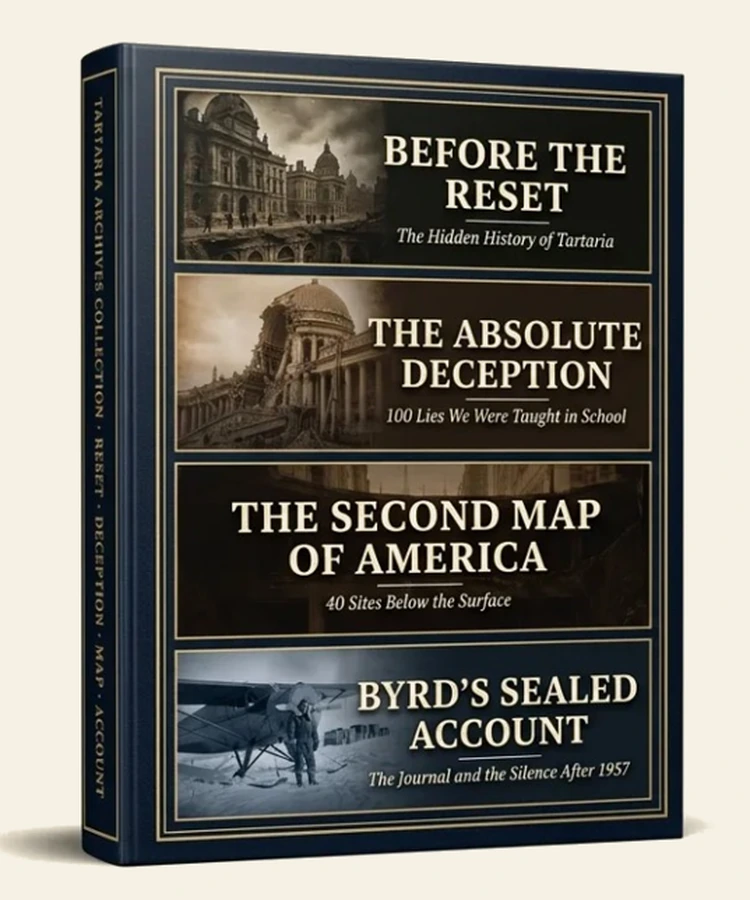
Four volumes on the century that was cut out of the record — the buildings raised and removed, the maps nobody made, the expedition nobody explained, and the discoveries that were filed and forgotten. 207 pages. 175 documented entries. Every claim is sourced against the record, and where the record does not support it, the book says so.

All four volumes — the full archive, in one download.

100 lies we were taught in school — and the truth each one was built to hide.

40 sites below the surface that appear on no official survey.

The journal, the deathbed claims, and the silence after 1957.

35 buried discoveries that point to a more advanced civilization before ours.
Start with one building. The Columbian Exposition of 1893 covered more than six hundred acres and held over two hundred structures. The Manufactures and Liberal Arts Building enclosed close to thirty-one acres under a single roof — the largest interior space on earth at the time. The official construction period is about twenty-two months, on filled marshland. Every photograph shows finished classical stonework: carved entablature, full colonnades, statuary at cornice height.
Within two years of the gates closing, almost all of it was gone. The same thing happened at Buffalo in 1901, St. Louis in 1904, San Francisco in 1915. Hundreds of monumental buildings, admired by millions, removed within months.
That is one entry out of a hundred in the first volume, and the same shape repeats across all four. Patent records burned twice. Half the counties in America lost their deeds. Newspapers were filmed and pulped by the institutions holding them. Mounds were levelled before anyone examined them. Old-growth forest was cut before anyone measured it. Calendars were shortened by decree; pitch, time zones and the prime meridian were fixed by committee.
None of that requires a single conspiracy, and this collection does not ask you to believe in one. It asks you to notice that the record of the last three hundred years has been cut, standardized, centralized and destroyed so many times over that large parts of it are no longer recoverable by anyone — and to look at what is still standing in the gaps.
Most of what circulates on this subject asserts as much as it can. These volumes were built the opposite way.
The real table of contents from each book — not a summary of them.
"I've watched a hundred videos on this subject and never once been told where to go and check. This tells you every time. The chapter on the missing diary changed my mind about something I'd believed for years."
"Two entries a page means I read one at breakfast and think about it all day. My son and I have been going through the site list and looking up each one. Forty of them and we've checked eleven so far."
"What sold me was that it tells you when a story doesn't hold up. I didn't expect that. It made me trust the rest of it a great deal more than I trust the usual thing."
The Tartaria Archives Collection is assembled from the public record: newspaper archives, geological surveys, patent registers, county deed books, expedition logs, institutional correspondence and photographs that were published once and then withdrawn. Nothing in it is invented, and nothing is asserted beyond what a source will carry.
These are books of historical argument and interpretation. They set documented events and open questions beside the accounts commonly taught, and where a matter is disputed, contested or unresolved, they say so. The strongest case in this subject is not the one that asserts the most. It is the one that survives being checked — so these were written to be checked.
All four volumes, in one instant download.
Only want one volume? Single files are $9.99 each →
It is historical argument and interpretation built on documented events, published records and open questions, set beside the accounts commonly taught. Where a matter is disputed, contested or unresolved, the text states that plainly — including where a popular claim runs ahead of the evidence. No claim is made that any interpretation here represents established academic consensus. Belief is left to the reader.
A video gives you one entry and then it is gone. These give you a hundred lies, forty sites, twelve chapters and thirty-five discoveries, indexed, in order, with the record behind each one, on a page you can return to. You cannot search a video for the entry you half-remember from three months ago.
Because there is no printing, no shipping and no distributor taking a cut. The files cost the same to deliver to one reader as to ten thousand. The launch price is what it is while the promo runs, and $9.99 buys any single volume on its own.
PDF, delivered instantly through Gumroad the moment the payment clears. It opens on a phone, a tablet, a laptop or a printer — no app, no account, no reader software required. The files are yours to keep.
No. That document has no manuscript, no provenance and no archival presence, and it places Byrd over the North Pole in February 1947 when naval records put him in Antarctica. Chapter eight sets out the case in full. What replaces it is the genuine 1938 journal, a real archive document found in 1996 with erasures in it, and an expedition of 4,700 men with no complete public account.
Many are on private land, on tribal land, inside operating infrastructure, or closed for reasons of safety, security or cultural protection. Nothing in the book is an invitation to enter any site without permission. Abandoned mines, lava tubes, flooded workings and unsurveyed passages kill people every year.
No. Each volume stands on its own at $9.99 and the four are unrelated in subject, though they rhyme. The collection is $14.99 for all four because most readers who finish one come back for the rest.

Less than one cinema ticket for 207 pages and 175 documented entries — the buildings, the sites, the journal and the discoveries, in a file that is yours to keep.
Get the Collection — $39.96 $14.99